Skip to content

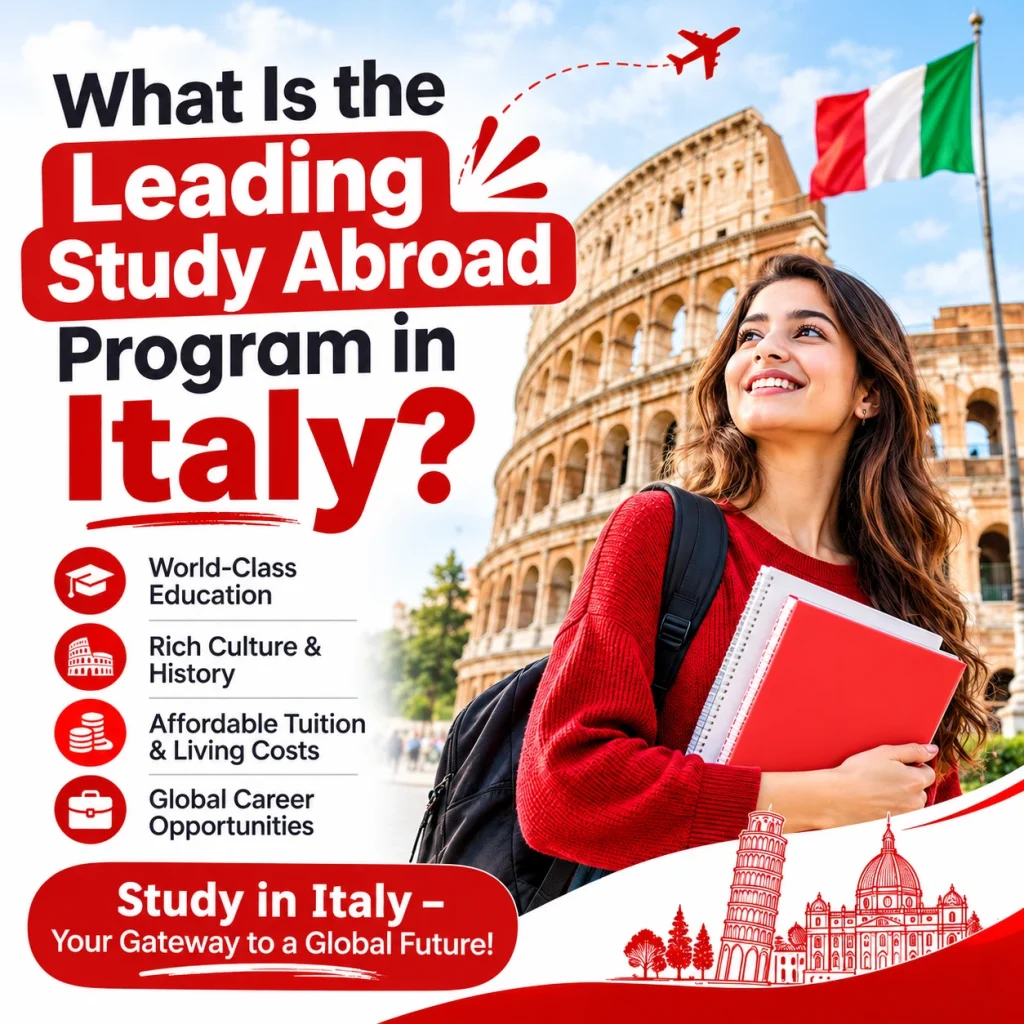
What Is the Leading Study Abroad Program in Italy? (2027)
There is no single official leading study abroad program in Italy, but the most established choices are John Cabot University in Rome, Lorenzo de' Medici (LdM) in Florence, and provider programs from CIEE, IES Abroad, CEA CAPA and SAI. For full Italian immersion, the University of Bologna leads.
The right pick depends on your major, your budget and how much Italian you want in daily life. This guide compares the top Italy study abroad programs with the latest published prices for 2027 intakes, explains the student visa step by step, and covers what past students say they wish they had known.
Leading Italy Study Abroad Programs at a Glance
We call a program "leading" when it has five things: credit that gets recognised (an accredited school or a US school of record), years of track record, a wide range of courses, strong on-site support and fair value. These 10 programs meet that bar.
| Program | City | Best for | Program type | Taught in |
|---|---|---|---|---|
| John Cabot University | Rome | A real university with classmates from many countries | American university in Italy | English |
| Lorenzo de' Medici (LdM) | Florence, Rome, Tuscania | The widest choice of art, design, fashion, food and business courses | Italian institute for international students | English |
| Florence University of the Arts (FUA) | Florence | Hands-on classes in hospitality, food, fashion and media | Italian institute (used by many providers) | English |
| IES Abroad | Rome, Milan | Business and music in Milan | Provider with its own centres | English + Italian |
| CEA CAPA | Florence, Rome | Housing and on-site support | Provider | English |
| CIEE | Florence, Rome, Milan | Structured semesters with excursions included | Provider | English |
| SAI Study Abroad | Rome, Florence, Milan and more | Access to partner schools such as John Cabot | Provider | English |
| CET Academic Programs | Florence, Siena | Small, inclusive programs | Provider | English + Italian |
| University of Bologna | Bologna | Full immersion and full degrees | Italian public university | Italian + English-taught degrees |
| NYU Florence / Syracuse Florence | Florence | Students of those universities | US branch campus | English |
Prices for each program are in the cost section below.
Not sure which Italy program fits your course and budget? Get a free shortlist from our counsellors.
Book Free ConsultationThe 10 Best Study Abroad Programs in Italy for 2027
1. John Cabot University, Rome
John Cabot University (JCU) is an American-style university in Rome's Trastevere neighbourhood, and all its classes are taught in English. You study next to full-degree students from many countries, not only other visiting Americans. Tuition for visiting students is $15,000 per semester for fall 2026 and spring 2027.
- Best for: international relations, business, art history and communications
- Good to know: classes feel close to a home-university standard, with less hand-holding than a provider program. Rome is big, so expect to commute by bus or tram.
2. Lorenzo de' Medici (LdM), Florence, Rome and Tuscania
LdM was founded in 1973 and is one of Italy's most established institutes for international students. Its main campus is in central Florence, with smaller sites in Rome and Tuscania. A full load is usually 15 credits: 12 credits of your choice plus a 3-credit Italian class.
- Best for: students of studio art, design, fashion, food and the humanities who want a wide choice of courses
- Good to know: attendance rules are strict, and missed classes lower your grade. Choose Tuscania if you want a small Italian town rather than a busy tourist city.
3. Florence University of the Arts (FUA), Florence
FUA is the school that teaches the classes for many provider programs, including CIEE's Semester in Florence. Many of its classes are hands-on and linked to real work in hospitality, food and wine, fashion and media.
- Best for: students of hospitality, cooking, fashion, media and design
- Good to know: quality varies from course to course, so read each syllabus before you enrol.
4. IES Abroad, Rome and Milan
IES Abroad runs its own centres, with its own teachers and academic rules. Milan is known for business and for a respected music program. Rome suits history, classics and international affairs.
- Best for: business and music students, and anyone whose home university is strict about credit
- Good to know: Milan is the most expensive student city in Italy, but it is the best for internships.
5. CEA CAPA, Florence and Rome
CEA CAPA is known for central, well-run apartments and close support on site. Its Florence program fee covers both tuition and housing.
- Best for: students abroad for the first time who want help on the ground
- Good to know: because so much is arranged for you, it is easy to stay in an English-speaking bubble.
6. CIEE, Florence, Rome and Milan
CIEE runs a Semester in Florence taught at FUA, a Semester in Rome with an Open Campus Block option, and a Business + Culture program in Milan. Excursions are included in the fee.
- Best for: students who want a structured semester with trips included
- Good to know: the Florence trimester lasts 12 weeks, shorter than a US semester, so check that it counts as full-time credit at your university.
7. SAI Study Abroad, Rome, Florence, Milan and more
SAI places students at partner schools across Italy, including John Cabot University in Rome. You take the partner school's classes and get SAI's housing and support on top.
- Best for: students who want a specific partner school plus extra services
- Good to know: SAI's fee at JCU ($20,850) is $5,850 more than JCU's own tuition ($15,000). Check which items that difference pays for.
8. CET Academic Programs, Florence and Siena
CET runs smaller programs known for inclusive support. Siena is a quiet medieval city where you hear far more Italian than English.
- Best for: students who want a close-knit group and real practice speaking Italian
- Good to know: at $22,990, CET Florence is the most expensive program in our cost table.
9. University of Bologna, Bologna
The University of Bologna was founded in 1088 and is the oldest university in the Western world. The city is a true student town. You can join through your home university's exchange program or enrol in an English-taught degree.
- Best for: full immersion, exchange students and full-degree students
- Good to know: teaching follows the Italian style: big lectures, oral exams and grades out of 30. Exam sessions run January to February and June to July, which may not match your home calendar.
10. NYU Florence and Syracuse University Florence
These are branch campuses run by US universities, mainly for their own students. NYU Florence is based at Villa La Pietra, a historic estate in the hills, and Syracuse Florence is in the city centre.
- Best for: students already enrolled at those universities
- Good to know: credits count straight toward your degree, so there is no risk of them not transferring.
Types of Study Abroad Programs in Italy
Every study abroad option in Italy is one of five types, and the type matters more than the brand. It decides who your classmates are, what you pay and how much Italian you will use.
| Type | Examples | Pros | Cons | Cost level |
|---|---|---|---|---|
| Provider program | CIEE, IES Abroad, CEA CAPA, SAI, AIFS | Housing, visa letters, excursions and 24/7 support are handled for you | Highest fees; most classmates are from the US | High |
| American university in Italy | John Cabot University | Real university life, international classmates, US-style credits | More independence, less hand-holding | Medium to high |
| Italian institute for international students | LdM, FUA | Huge choice of courses, taught in English, flexible terms | Most classmates are visiting students | Medium |
| Direct enrollment or exchange | University of Bologna, Sapienza Rome, University of Padua, Bocconi | Real Italian student life; on an exchange you often pay home tuition | More paperwork, Italian-style exams, fewer courses in English | Low |
| Branch campus of your university | NYU Florence, Syracuse Florence | Credits count automatically | Only open to that university's students | Home tuition |
Most universities that offer study abroad in Italy use one of these routes. Ask your study abroad office which exchange partners let you pay home tuition. That is usually the cheapest way to go.
Best Place to Study Abroad in Italy: City-by-City Guide
Florence is the best place to study abroad in Italy for art and choice of programs. Bologna and Siena are better if you want to live in Italian. Pick the city before the program, because it shapes your whole semester.
| City | Best for | What daily life is like | Living costs |
|---|---|---|---|
| Florence | Art, architecture, fashion, food; the most programs to choose from | A small, walkable Renaissance centre. It hosts more American students than any other Italian city, so you hear English everywhere | High |
| Rome | History, classics, international relations, film | A big, busy capital with more everyday Italian life. You will ride buses and trams | High |
| Milan | Business, fashion, design, engineering, music | Fast and modern, with the best internships, but less "postcard Italy" | Highest |
| Bologna | Immersion, exchanges, full degrees, food | A true student town, cheaper than Florence. Speaking Italian helps a lot | Medium |
| Siena | Learning Italian, small-town life | A quiet medieval city with few foreign students | Medium |
| Tuscania | Total immersion (LdM campus) | A tiny town in the Lazio countryside; very quiet at night | Lower |
How Much Does It Cost to Study Abroad in Italy in 2027?
A semester program in Italy costs about $15,000 to $23,000 at the latest published fees, and most of those fees include housing. Fees usually rise a little each year, so expect fall 2027 prices to be slightly higher. On top of that, plan for $8,000 to $10,000 for flights, food, your phone, local transport and weekend travel.
| Program | Published fee (USD, per semester) | What the fee includes | Term |
|---|---|---|---|
| LdM (tuition only) | About $9,300 | Tuition for 12 credits; housing, insurance and extra courses cost more | 2025 figure |
| John Cabot University (direct) | $15,000 | Tuition only; optional housing $7,050 and meal plan $2,075 | Fall 2026 and spring 2027 |
| CIEE Rome | $15,550 | Tuition and housing | Spring 2026 |
| CIEE Florence (12 weeks) | $18,950 | Fees and housing | Fall 2026 |
| CEA CAPA Florence | $19,264 | Tuition and housing | Spring 2026 |
| SAI at John Cabot, Rome | $20,850 | Provider fee for 12-17 credits | Fall 2026 |
| CET Florence | $22,990 | $18,000 tuition + $4,990 housing and student life | 2026-27 |
These are the latest published fees (fall 2026 to spring 2027). Fall 2027 prices may be higher, and some figures come from US universities' cost sheets. Confirm the current price on each program's own website.
Costs not included in the program fee
One Florence cost sheet adds $9,414 for meals, personal spending and flights to a $19,264 program fee, for a total of $28,678. Costs that are often left out of the fee:
- Return flights
- Meals, if your program does not include them
- A local transport pass and train tickets
- The visa fee (about €50) and the costs of the residence permit (the application kit, a revenue stamp and the card fee)
- Health insurance, if your program does not include it
Two biggest ways to save
- Go on an exchange: you pay your home university's tuition, not a provider fee of $15,000 or more.
- Pick a cheaper city: living costs in Bologna or Siena are lower than in Milan or Florence.
Not sure which Italy program fits your course and budget? Get a free shortlist from our counsellors.
Book Free ConsultationStudy Abroad in Italy Visa Requirements (Step by Step)
If you are not an EU citizen and will stay longer than 90 days, you need an Italian National (Type D) study visa before you fly. You must also apply for a residence permit within 8 days of arriving.
Which visa do you need?
| Your situation | What you need |
|---|---|
| EU citizen | No visa; register locally if you stay over 3 months |
| Program of 90 days or less, and your passport is visa-free (US, Canada, UK, Australia) | No study visa; check the EU's entry rules for your travel dates |
| Program of 90 days or less, and your passport needs a Schengen visa (for example India) | A short-stay Schengen (Type C) visa |
| Semester, year or full degree, any non-EU passport | A National Type D study visa, then a residence permit after you arrive |
Steps for a Type D study visa
- Get your acceptance letter from the program or university. Full-degree students also complete pre-enrolment on the Universitaly portal.
- Book an appointment at the Italian consulate or visa centre that covers where you live. Americans apply through the consulate that covers their home state.
- Gather your documents: passport, visa application form, acceptance letter, proof of funds, health insurance, proof of housing and flight details.
- Attend the appointment and pay the visa fee, which is about €50. Processing usually takes several weeks, so apply at least 2-3 months before you leave.
- Within 8 days of arriving, apply for your permesso di soggiorno (residence permit). Pick up the permit kit at a Poste Italiane post office, send it, and attend your appointment at the police office (Questura) to give fingerprints. Some offices count the 8 days as working days, but go as early as you can.
- Keep the post office receipt with your passport. It proves you are in Italy legally while you wait for the card.
- Get your codice fiscale (Italian tax code). You need it for a phone contract, a lease and many forms.
2027 visa timeline
| Your 2027 start | Apply to the program by | Book your visa appointment by |
|---|---|---|
| Summer 2027 (May to August) | February to March 2027 | Only needed if your passport requires a Schengen visa: March to April 2027 |
| Fall 2027 semester (September) | March to April 2027 | May to June 2027 |
| Full degree (September or October 2027) | January to April 2027 | June to July 2027, right after Universitaly pre-enrolment |
| Spring 2028 semester (January) | September to October 2027 | October to November 2027 |
Summer Study Abroad Programs in Italy
Summer 2027 study abroad programs in Italy run for 3 to 8 weeks between May and August, and they cost far less than a semester.
- LdM summer sessions: one-month sessions in Florence, Rome or Tuscania
- NYU Florence summer: a fast-paced program with courses in social research, public policy and law
- FUA summer, Florence: hands-on courses in food, wine, hospitality and design
- John Cabot University summer, Rome: sessions taught in English, with credits on a US-style transcript
- Atlantis clinical shadowing: hospital observation hours for pre-med and pre-health students
- Performing Arts Abroad, Florence: for music students
- LEAD Italy: a four-week leadership program across Rome, Florence and Tuscany, with 6 credits from Oglethorpe University (21 June to 17 July 2027)
July and August are very hot in Florence and Rome, and many older flats have no air conditioning, so ask about AC before you book. Many local shops and restaurants also close for a week or two around Ferragosto, the public holiday on 15 August.
How to Study in Italy for a Full Degree (International Students)
If you want a whole bachelor's or master's degree rather than one semester, Italy is one of the best-value countries in Europe. Public universities set fees based on family income, many degrees are taught in English, and students can work part-time.
- Pick a degree taught in English. Popular public universities include the University of Bologna, Politecnico di Milano, the University of Padua and Sapienza University of Rome. Bocconi in Milan is a leading private university for business.
- Apply to the university. For courses starting in September or October 2027, many deadlines for non-EU students fall between January and April.
- Pre-enrol on Universitaly, then apply for your Type D study visa.
- Apply for fees based on income. If your family's income is outside Italy, you request an "ISEE parificato" (a calculation of family income for fees) through an approved tax assistance office, called a CAF. At Politecnico di Milano, the highest fee band is about €3,900 a year, and lower-income students pay much less.
- Apply for a regional DSU scholarship. These grants are based on income. They can waive tuition and add a cash grant, a subsidised room and cheap meals. You apply to the regional agency, separately from your university, usually in summer.
- Plan your work hours. With a study residence permit, you can work up to 20 hours a week and 1,040 hours a year.
Students from countries such as India should start 9 to 12 months before the course begins. Documents about family and income for fee reductions and scholarships usually need an official translation and legalisation, which takes several weeks.
How to Study Abroad in Italy for Free (or Close to It)
A completely free semester in Italy is rare, but scholarships and exchanges can cut the cost by thousands of dollars. Full-degree students with a low family income come closest to studying for free, through regional DSU grants.
| Option | Who it is for | What it can cover |
|---|---|---|
| Exchange through your home university | Students whose university has Italian partner schools | You pay home tuition instead of a program fee |
| Gilman Scholarship | US undergraduates who receive a Pell Grant | Up to $5,000 toward study abroad |
| Provider scholarships (CEA CAPA, IES Abroad, CIEE, SAI, AIFS, CET) | Students on those programs | Partial discounts on fees, and grants |
| Regional DSU scholarships | Full-degree students with a low family income | Fee waiver, cash grant, subsidised housing and meals |
| Invest Your Talent in Italy | Master's students from selected countries, including India | Tuition support and a monthly stipend, for eligible subjects |
| Italian Government (MAECI) scholarships | Foreign students on degree and research programs | A monthly grant; the amount changes with each call for applications |
| University merit scholarships | Strong applicants at Bocconi, Politecnico di Milano, Padua and other universities | Fee waivers and cash awards |
What Students Wish They Knew Before Studying Abroad in Italy
Past students rarely regret choosing Italy. Their regrets are about the details below, which brochures leave out.
- Florence can feel like an American campus. If you want to speak Italian every day, choose a homestay, Bologna, Siena or LdM's Tuscania campus.
- Attendance counts toward your grade. Many institutes set a limit on absences, so skipping a Friday class for a long weekend trip can cost you a letter grade.
- Many older flats have no air conditioning. Heating is only allowed during months and hours set by law, and tumble dryers are rare. Ask about all three before you sign.
- The residence permit card can arrive late. Some students only get it near the end of the semester. The post office receipt is what matters, so keep it with your passport.
- Strikes (scioperi) are normal. Train and transport strikes are announced in advance, so check the strike calendar before you book travel.
- Exams can be oral. If you enrol directly at an Italian university, oral exams and grades out of 30 are normal. Ask your home university how it converts those grades.
- Get every course approved in writing. Do it before you pay a deposit. If you don't, you risk earning credits that never transfer.
Not sure which Italy program fits your course and budget? Get a free shortlist from our counsellors.
Book Free ConsultationHow to Choose the Right Study Abroad Program in Italy: 8-Point Checklist
Ask each program on your shortlist these 8 questions before you apply.
- Do they teach the exact courses you need, in the term you plan to go?
- Does the transcript come from a US-style school or a US school of record? And has your home department approved each course in writing?
- Who will your classmates be? Mostly visiting Americans (provider programs, LdM), a mix of nationalities (JCU), or Italian students (direct enrollment)?
- What is the total cost? Take the program fee, add $8,000 to $10,000 for costs it doesn't cover, then subtract any scholarships.
- Does the housing have AC, heating and a washing machine? How many roommates will you have, and how many minutes is the walk to class?
- How many absences are allowed? And how do grades convert at your home university?
- Do they help with the residence permit? Is health insurance included in the fee?
- Do the start and end dates fit your home university's calendar? When is the application deadline?
Is Studying Abroad in Italy Worth It?
Yes, for most students who plan ahead. You earn credit while living in one of the world's great centres of art, history, design and food, and Italy is one of the most popular study abroad destinations for American students.
It pays off most when your credits transfer and your budget is set before you leave. If a full semester would stretch your finances, a summer program or an exchange through your home university gives you most of the experience for less money.
Final word
The leading study abroad program in Italy is the one that fits you:
- JCU, if you want a real university in Rome
- LdM, if you want the widest choice of courses in Florence
- A provider program, if you want support on the ground
- The University of Bologna, if you want full immersion
Pick two or three from the tables above, get your courses approved, then compare total costs.
Get Your Free Italy Study Abroad Shortlist
Tell us your course, budget and intake, and our counsellors will suggest the best-fit programs, costs and visa steps.
Frequently Asked Questions About Studying Abroad in Italy
1. What is the leading study abroad program in Italy?
There is no single official leader. John Cabot University in Rome and Lorenzo de' Medici (LdM) in Florence are the most established, along with provider programs from CIEE, IES Abroad, CEA CAPA and SAI. For full immersion and full degrees, the University of Bologna leads.
2. Which city in Italy is best for studying abroad?
Florence has the most programs and is best for art, design and food. Rome suits history and international relations, Milan suits business and fashion, and Bologna is best if you want to live like an Italian student.
3. How much does it cost to study abroad in Italy?
A semester program costs about $15,000 to $23,000 at the latest published fees, often with housing included. Fall 2027 prices are likely to be a little higher. Add about $8,000 to $10,000 for flights, food, travel and personal costs. Summer programs cost much less.
4. Do I need a visa to study abroad in Italy?
Non-EU students staying more than 90 days need a National Type D study visa, and must apply for a residence permit within 8 days of arriving. Citizens of the US, Canada, the UK and Australia need no study visa for programs of 90 days or less. Indian citizens need a Schengen visa even for short programs.
5. Can you study abroad in Italy without speaking Italian?
Yes. Almost all study abroad programs teach in English, and most include an Italian class, either required or optional. Full-degree students can also choose from many bachelor's and master's degrees taught in English.
6. Can I study abroad in Italy for free?
A completely free semester is rare, but you can get close. Exchange students pay their home university's tuition, and Gilman and provider scholarships cut costs. Full-degree students with a low family income can win regional DSU grants that waive fees and help with living costs.
7. What GPA do you need to study abroad in Italy?
Many programs ask for a minimum GPA of about 2.5 on a 4.0 scale, and competitive programs ask for 3.0. Requirements vary, so check each program's website, and ask whether a recommendation letter can make up for a lower GPA.
8. Is it safe to study abroad in Italy?
Italy is generally safe for students, and violent crime against visitors is rare. The main risk is pickpocketing on crowded buses and metros and at big stations such as Roma Termini. The EU emergency number is 112.
9. Will my credits transfer from a study abroad program in Italy?
Yes, if your home university approves each course before you go. Transfer is easier when the program gives you a US-style transcript or uses a US school of record. Always get the approval in writing.
10. Is Italy good for international students?
Yes. Public universities charge fees based on family income, many degrees are taught in English, and students can work up to 20 hours a week. You can also travel easily across the Schengen area.
11. Can I work while studying in Italy?
Students with a study residence permit can work up to 20 hours a week and 1,040 hours a year. Semester students rarely work, and some programs do not allow it, so check your program's rules first.
12. Should I study abroad in Italy or Spain?
Choose Italy for art, design, architecture, fashion, history and food. Choose Spain if your main goal is to learn a widely spoken language, or if you want lower living costs. Both countries have strong programs taught in English.
13. Can adults study abroad in Italy?
Yes. Adults can join language schools, art and cooking courses, or master's programs, and many of these accept students of any age. Non-EU citizens still need a Type D study visa for courses longer than 90 days.
14. Are there high school study abroad programs in Italy?
Yes. High school students can join summer programs, gap-year programs or a full exchange year living with a host family. Most programs are for students aged about 15 to 18.
15. When should I apply for a study abroad program in Italy?
For fall 2027, apply by March or April 2027. For spring 2028, apply by September or October 2027. Full-degree students starting in September or October 2027 should apply between January and April 2027, because that is when many deadlines for non-EU students fall.

Mr. Suman Prem is the Founder and CEO of GIEC Global India, an international education and immigration consultancy serving students, skilled professionals, and families across India. With experience in the education and migration industry, he leads the organisation in helping individuals explore international study opportunities, student visas, skilled migration, permanent residency (PR), and other immigration pathways.
Under his leadership, GIEC Global has developed a presence across multiple international destinations, supporting clients with overseas university admissions, education counselling, visa guidance, and immigration services. The organisation focuses on providing personalised guidance, transparent communication, and professional support to help clients make informed decisions about their international education and migration goals.