Skip to content
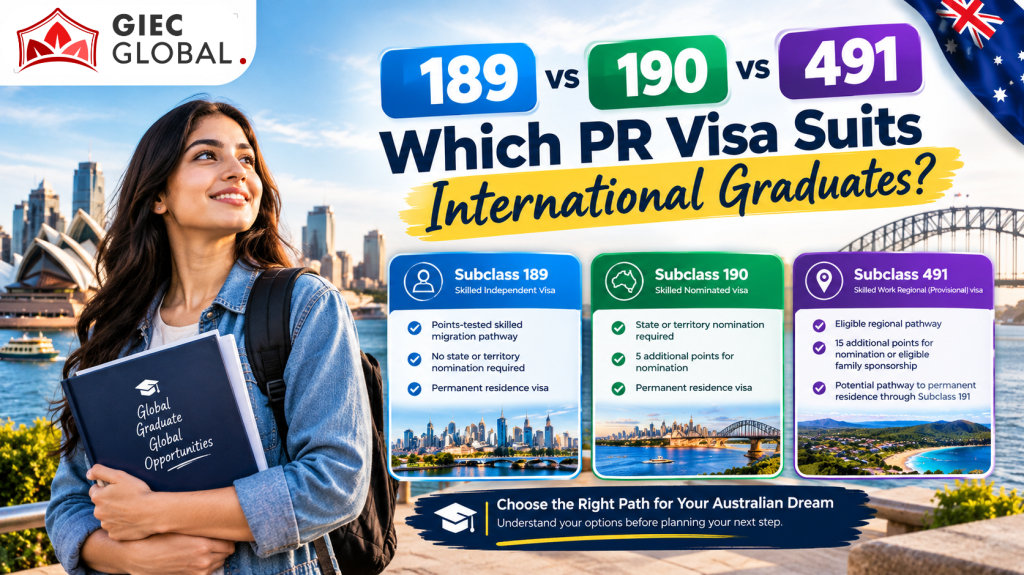
189 vs 190 vs 491 in 2026: Which PR Visa Suits International Graduates? A 491 Visa Consultant Explains
You finished your degree, your points add up to 65 or more, and three visa numbers keep coming up: 189, 190 and 491. Pick the wrong one and you can lose a year waiting for an invitation that was never likely to come.
As a 491 visa consultant team that works with Indian graduates every week, we see the same confusion in 2026. The rules moved a lot this year. Regional places were cut by more than half, visa fees rose by about 25%, and a new processing order now decides whose file is opened first.
This guide compares the three visas using figures checked in October 2026. You will learn how each visa works, what changed this year, how your points and occupation shape your options, what each route costs, and how to choose between them. We also explain where a 491 visa consultant adds value and where you can manage on your own.
Key Takeaways
- The AU 189 visa gives permanent residency (PR) with no sponsor, but invitations go to the highest scores in each occupation.
- The 190 visa gives PR on grant and 5 extra points, in return for state nomination.
- The 491 visa is a five-year provisional visa with 15 extra points. PR comes later through the subclass 191, after three years in regional Australia.
- For 2026-27, Regional places fell from 33,000 to 14,110. Skilled Independent rose to 21,090 and State Nominated to 35,500.
- From 1 July 2026 the base charge is AUD 6,135 for the 189 and AUD 6,140 for the 190 and 491.
- Since 19 September 2026, priority-sector occupations and people who applied from inside Australia are processed first.
- A new points test has been announced but is not law. EOIs are still scored under the current test.
- A 491 visa consultant helps most with state selection, points claims and timing.
189, 190 and 491 Visas at a Glance in 2026
All three are points-tested skilled visas run under Australia's General Skilled Migration program through SkillSelect, the Australian Government's online Expression of Interest (EOI) system. They share the same base rules:
- You are under 45 when invited.
- You hold a positive skills assessment in an eligible occupation.
- You have at least competent English (IELTS 6 in each band, or equivalent).
- You score 65 points or more.
- You receive an invitation before you can lodge.
The difference lies in who backs you, where you must live, and whether you get PR on day one. The table below compares the three on the points that matter most to a recent graduate. It is the same side-by-side a 491 visa consultant would sketch in your first meeting.
| Feature | Subclass 189 | Subclass 190 | Subclass 491 |
|---|---|---|---|
| Visa type | Permanent | Permanent | Provisional, 5 years |
| Who backs you | No one | A state or territory | A state or territory, or an eligible relative in regional Australia |
| Extra points | 0 | 5 | 15 |
| Where you can live | Anywhere in Australia | The nominating state, usually for 2 years | Designated regional areas only |
| Occupation lists | MLTSSL | MLTSSL, STSOL | MLTSSL, STSOL, ROL |
| 2026-27 places (category) | 21,090 | 35,500 | 14,110 |
| Base charge from 1 July 2026 | AUD 6,135 | AUD 6,140 | AUD 6,140 |
| Processing: 50% / 90% decided in | 61 days / 8 months | 4 months / 16 months | 5 months / 18 months |
| Route to PR | PR on grant | PR on grant | Subclass 191 after 3 years |
AU 189 Visa: Skilled Independent
The AU 189 visa is the cleanest route. No state, employer or relative is involved. You can live and work anywhere in Australia from the day it is granted.
The catch is competition. The Department runs the invitation rounds itself and invites the highest-ranked EOIs in each occupation. In the 4 June 2026 round, 10,000 invitations went out and minimum scores ranged from 65 to 100 points depending on occupation. A 491 visa consultant will often tell high scorers to try the 189 first.
190 Visa: Skilled Nominated
The 190 visa is also permanent. A state or territory nominates you, which adds 5 points to your score. In return you are expected to live and work in that state, usually for at least two years.
Each state sets its own occupation list, criteria and intake. Many give preference to people already living or studying there, which helps graduates of Australian universities. It is the visa a 491 visa consultant most often pairs with a 491 application as a second option.
491 Visa Australia: Skilled Work Regional (Provisional)
The 491 visa is a five-year provisional visa. You are nominated by a state or territory, or sponsored by an eligible relative living in a designated regional area. Nomination adds 15 points, the largest single boost in the points test. Ask any 491 visa consultant and those 15 points are the reason this visa is so popular.
You must live, work and study in regional Australia. That covers most of the country outside Sydney, Melbourne and Brisbane, so Perth, Adelaide, Canberra, Hobart and the Gold Coast all qualify. After three years you can apply for PR through the subclass 191 visa. Our guide on whether you can get PR in Australia in three years explains how that timeline works.
What Changed in 2026 for Skilled Visa Applicants
2026 has been a busy year for skilled migration. A 491 visa consultant who is still quoting last year's numbers will hand you the wrong plan. The table below sets last year's settings beside the current ones.
| Area | 2025-26 | 2026-27 (current) |
|---|---|---|
| Skilled Independent (189) places | 16,900 | 21,090 |
| State/Territory Nominated (190) places | 33,000 | 35,500 |
| Regional category places (includes 491) | 33,000 | 14,110 |
| Base visa charge, main applicant | AUD 4,910 | AUD 6,135 (189); AUD 6,140 (190, 491) |
| Processing order | Direction 105, in place until 24 July 2026 | Direction 122 from 19 September 2026: priority sectors first, then onshore applicants |
| Points test | Current test, 65-point minimum | Same test still applies; a redesign is announced with no start date |
Fewer Regional Places, More 189 and 190 Places
The total permanent program stays at 185,000 places under the 2026-27 Migration Program planning levels, with 132,240 in the Skill stream. Inside that, the Regional category was cut by more than half while the 189 and 190 categories grew.
For graduates, this ends the old advice that the 491 is the easy option. The 15 points still help, but states have fewer regional places to hand out and are choosier about who gets them. Be wary of any 491 visa consultant who promises a quick regional nomination this year.
The Government has also said it will prioritise people already in Australia, planning 129,590 of the 185,000 places for onshore migrants.
Higher Visa Fees From 1 July 2026
Most visa application charges rose by about 25% on 1 July 2026. The main applicant now pays AUD 6,135 for a 189 and AUD 6,140 for a 190 or 491, up from AUD 4,910. The fee that applies is the one in force on the day you lodge. Ask your 491 visa consultant for a written cost estimate before you start.
A New Processing Order Under Direction 122
Since 19 September 2026, Ministerial Direction 122 sets the order in which case officers pick up 189, 190 and 491 files. It also covers applications lodged earlier that are still waiting. The order is:
- Occupations in construction, healthcare, teaching, agriculture, aquaculture, fishing and resources, plus law enforcement and defence roles, whether onshore or offshore.
- All other main applicants who were in Australia when they lodged.
- Offshore main applicants who applied on their own.
- All other applications.
An Indian nurse or school teacher applying from Delhi now sits in the first group. An accountant or software engineer applying from India sits in the third or fourth. Ask your 491 visa consultant which group your occupation falls in.
Points Test Reform: Announced, Not Law
The 2026-27 Budget confirmed a redesign of the points test to favour younger, better-qualified and higher-skilled applicants. On 17 September 2026 the Minister for Home Affairs said the new test would give housing trades the same points as a university degree.
Changes That Affect Graduates in Australia
If you studied in Australia, three more changes matter:
- The Temporary Graduate visa (subclass 485) now costs AUD 5,750 for the main applicant, after two increases in 2026.
- The 485 age limit is 35 for most applicants.
- From 2 October 2026, most temporary visa holders, including 485 holders, cannot apply for a Student visa from inside Australia.
491 Visa Requirements in 2026: What a 491 Visa Consultant Checks First
The 491 visa requirements have not changed in law this year, but the bar for nomination has risen. Before taking your case, a careful 491 visa consultant will confirm that you:
- Are under 45 at the time of invitation.
- Have a positive skills assessment for an occupation on the relevant list.
- Have at least competent English.
- Score 65 points or more, including the 15 nomination points.
- Hold a nomination from a state or territory, or sponsorship from an eligible relative settled in a designated regional area.
- Meet health and character requirements, along with any family members you include.
- Have lodged an EOI and received an invitation.
State nomination adds its own layer. A state may ask for a regional job offer, a period of residence in the state, a local qualification or work experience in a target sector.
Living in a Designated Regional Area
A 491 visa carries a condition that you live, work and study only in designated regional areas. You can move between regional areas, including across states, but you cannot settle in Sydney, Melbourne or Brisbane.
Holders also generally cannot apply for most other skilled visas until they have held the 491 for three years. Choose the 491 only if you are ready to build your life in a regional city. A 491 visa consultant should explain this condition before you accept a nomination.
From the 491 Visa to PR Through the Subclass 191
The 491 does not convert to PR automatically. For the subclass 191 you must have held your 491 for at least three years, complied with its conditions, and provide Australian Taxation Office notices of assessment for three income years.
In practice that means three years of living, working and lodging tax returns in regional Australia. Keep rental agreements, payslips and utility bills from your first month. Your 491 visa consultant can give you a record-keeping checklist.
Points Test in 2026: How Graduates Reach 65 and Beyond
Sixty-five points lets you lodge an EOI. It rarely wins an invitation on its own. Your real target depends on your occupation and the visa you choose, which is why a 491 visa consultant will usually run your score three ways.
Where Graduates Pick Up Points
Under the current test, these are the factors most graduates can use:
- Age: 25 points for ages 18 to 24, 30 points for 25 to 32, 25 points for 33 to 39.
- English: 10 points for proficient (IELTS 7 in each band), 20 for superior (IELTS 8 in each band).
- Qualification: 15 points for a bachelor's or master's degree, 20 for a doctorate.
- Australian study: 5 points for two academic years of study in Australia, plus 5 more if it was in a regional area.
- Professional Year: 5 points for accounting, ICT or engineering graduates.
- Community language: 5 points, for example through NAATI's CCL test in Hindi or Punjabi.
- Partner status: 10 points if you are single or your partner is skilled, 5 if your partner has competent English.
- Work experience: 5 to 20 points depending on years and whether the work was in Australia or overseas.
- Nomination: 5 points for the 190 visa, 15 for the 491.
A 491 visa consultant will check every claim against your documents before it goes into the EOI. Use our Australia PR points calculator for a quick estimate, and read how to calculate Australia PR points for the fine detail.
Two Worked Examples
Aman, 26, master's graduate in Melbourne. Age 30, proficient English 10, master's degree 15, Australian study 5, single 10, one year of skilled Australian work 5. Total: 75 points. With a 190 nomination he has 80. With a 491 nomination he has 90.
Priya, 28, B.Tech graduate working in Pune. Age 30, superior English 20, bachelor's degree 15, three years of overseas experience 5, single 10. Total: 80 points. With a 190 nomination she has 85, and with a 491 nomination 95.
Aman has fewer points, but he is onshore and may fit a graduate stream in a state program. Priya has more points but sits lower in the processing order unless her occupation is in a priority sector. Points are only half the picture, and this is the comparison a 491 visa consultant makes every day.
English Tests After the August 2025 Changes
English is the fastest way to add points, which is why IELTS and PTE preparation sits at the centre of most PR plans.
On 7 August 2025 the list of accepted tests widened to include CELPIP General, LANGUAGECERT Academic and the Michigan English Test, alongside IELTS, PTE Academic, TOEFL iBT, OET and Cambridge C1 Advanced. At-home online versions are not accepted.
PTE Academic score requirements also changed on that date. If you sat PTE earlier, check the older score table. Those results can be used until 6 August 2028, within the usual three-year validity.
A 491 visa consultant with in-house IELTS and PTE coaching can plan your test dates around your EOI.
491 Visa Occupation List and Skills Assessments
Your occupation decides which of the three visas is open to you. It is the first thing a 491 visa consultant should check.
Which Occupation List Applies to Each Visa
- 189 visa: your occupation must be on the Medium and Long-term Strategic Skills List (MLTSSL).
- 190 visa: the MLTSSL or the Short-term Skilled Occupation List (STSOL).
- 491 visa, state nominated: the MLTSSL, STSOL or Regional Occupation List (ROL).
- 491 visa, family sponsored: the MLTSSL only.
The 491 visa occupation list is therefore the widest of the three. Some occupations appear only on the ROL, which makes the 491 the single points-tested option for them.
There is a second filter. Each state publishes its own list, and it is usually shorter than the national one. An occupation can be eligible federally and still closed in the state you want. A 491 visa consultant tracks these state lists as they change. Direction 122 did not change any of these lists.
ACS, Engineers Australia and VETASSESS for Graduates
A skills assessment shows that your qualification and experience match Australian standards. You need it before you lodge an EOI.
- ACS assesses ICT occupations such as software engineer, developer and ICT business analyst.
- Engineers Australia assesses engineers. See our Australia PR pathway for engineers. Graduates of accredited programs use a shorter pathway. Others submit a Competency Demonstration Report.
- VETASSESS covers a wide range of professional occupations, from marketing specialist to management roles, and usually expects relevant work experience after graduation.
Nurses, teachers, accountants and trades have their own authorities. Assessments expire, so time yours to stay valid through to invitation.
A common graduate mistake is choosing the occupation that sounds closest to a job title. The assessing authority looks at your duties and subjects, not your designation. If you are unsure, ask a 491 visa consultant to compare the ANZSCO descriptions with your transcript.
491 Visa Processing Time vs 190 Visa Processing Time
Home Affairs publishes two figures for each visa: how long it took to decide 50% of recent applications, and how long for 90%. The table below shows the figures in its visa processing times guide as checked on 2 October 2026. It also shows the lodgement dates the Department said it had reached for applicants outside the priority sectors.
| Visa | 50% decided in | 90% decided in | Onshore queue: lodged in or before | Offshore queue: lodged in or before |
|---|---|---|---|---|
| 189, points-tested | 61 days | 8 months | June 2026 | November 2025 |
| 190 | 4 months | 16 months | January 2026 | February 2025 |
| 491, state nominated | 5 months | 18 months | March 2025 | February 2025 |
Why Offshore Applicants Wait Longer
The 190 visa processing time looks short at the 50% mark, but the gap between the two queues is wide. In early October, onshore 190 files outside the priority sectors were about nine months old when picked up. Offshore files were about twenty months old.
The 491 visa processing time is slower across the board, with even onshore files dating from March 2025. The family-sponsored 491 stream is quicker, at 4 months for half of cases and 7 months for 90%. When clients ask our 491 visa consultant team about timelines, we give both numbers and the queue date.
189 Invitation Rounds in 2026-27
The 189 is the fastest visa once lodged, but you cannot lodge without an invitation. The last round was on 4 June 2026, as shown on the SkillSelect invitation rounds page. As at early October, no 189 invitations had been issued in the 2026-27 program year, and the Department expected the next round by 31 October 2026.
Keep your EOI current. If your points change, update it the same day. A 491 visa consultant can also keep a 190 or 491 nomination moving while you wait for a round.
What Each Visa Costs in 2026
The visa charge is the biggest single cost but not the only one. Budget for:
- Visa application charge: AUD 6,135 (189) or AUD 6,140 (190 and 491) for the main applicant. Extra charges apply for each family member.
- Skills assessment: set by each assessing authority and varies by pathway.
- English test: IELTS, PTE or another accepted test. Many applicants sit it more than once.
- State nomination fee: charged by some states, free in others.
- Health examinations and police certificates: for every country you have lived in for 12 months or more.
- Second instalment: payable for adult family members with less than functional English.
The visa charge is not refunded if the application is refused. That is the strongest argument for having your eligibility checked before you pay, whether by a 491 visa consultant or a registered migration agent.
Which PR Visa Suits You? A Decision Guide for Graduates
There is no best visa in general. There is a best visa for your occupation, points and location. A 491 visa consultant should show you recent invitation data for your occupation before recommending a route.
Choose the 189 Visa If
- Your occupation is on the MLTSSL.
- Your score is well above the recent cut-off for your occupation.
- You want full freedom over where you live.
- You can wait for a round without your current visa running out.
Choose the 190 Visa If
- You are a few points short for the 189 and 5 points would help.
- You studied or work in a state that nominates your occupation.
- You are happy to commit to that state for the first two years.
- You want PR on grant instead of a provisional visa.
Choose the 491 Visa If
- You need the 15 points to be competitive.
- Your occupation is only on the STSOL or ROL.
- You already live in, or are willing to move to, a regional city.
- You have an eligible relative in regional Australia who can sponsor you. A 491 visa consultant can confirm whether the relationship qualifies.
Graduates in Australia vs Applicants in India
If you graduated in Australia, your location is an asset. You sit higher in the processing order, you may qualify for state graduate streams, and you can add points through a Professional Year or a year of skilled work. Your deadline is the end of your 485, so book time with a 491 visa consultant at least a year before it expires.
If you are applying from India, an experienced 491 visa consultant will check three things first: whether your occupation falls in a Direction 122 priority sector, which states still invite offshore applicants this year, and whether you have a relative in regional Australia. Some state pathways for overseas applicants were reduced for 2026-27, so confirm each state's current position before you pay for anything.
How to Apply: Seven Steps From Graduate to Invitation
- Confirm your occupation and list. Match your degree and duties to an ANZSCO occupation.
- Get your skills assessment. Apply to ACS, Engineers Australia, VETASSESS or the relevant authority.
- Sit your English test. Aim for proficient at minimum, superior if you can.
- Calculate your points. Claim only what you can prove with documents.
- Lodge your EOI in SkillSelect. Select the 189, 190 and 491 where you qualify.
- Apply for state nomination. Each state has its own step for the 190 and 491. Your 491 visa consultant or migration agent can track opening dates.
- Lodge the visa application after invitation. You usually have 60 days. Upload complete documents from day one.
For the full eligibility picture, see our Australia PR requirements for Indians guide. You can do all seven steps yourself. A 491 visa consultant mainly saves you time on steps 1, 4 and 6, where most errors happen.
Common Mistakes Graduates Make
A good 491 visa consultant earns the fee mostly by preventing these errors:
- Over-claiming points. If you cannot prove a claim at the visa stage, the application can be refused and the fee lost.
- Letting documents expire. An English test or skills assessment that lapses before invitation sends you back to the start.
- Picking a state by rumour. "Easiest state" lists go out of date within weeks. Ask a 491 visa consultant for the state's current published criteria.
- Ignoring the regional condition. Taking a 491 and then working in Sydney puts the visa and the 191 pathway at risk.
- Waiting for the new points test. Nobody knows the final design. Plan on the rules in force today.
- Running out of visa time. Graduates on a 485 often start the skills assessment too late.
- Using unregistered agents. The next section explains how to check.
How to Choose a 491 Visa Consultant in India
The word "consultant" covers everything from a registered professional to a one-room shop with a banner. In October 2026 the Australian Government said it had set up a dedicated team to go after unregistered operators. Check before you sign with any 491 visa consultant.
- Ask who gives the advice. Australian immigration assistance should come from a registered migration agent or an Australian legal practitioner. Ask for the Migration Agents Registration Number (MARN) and verify it on the official OMARA register.
- Ask for a written assessment. A reliable 491 visa consultant will put your occupation, points and state options on paper before discussing fees.
- Watch for guarantees. No 491 visa consultant can promise an invitation or a grant.
- Test how current they are. Ask about Direction 122 and the 2026-27 planning levels. If they have heard of neither, walk away.
- Get a fee agreement. Your 491 visa consultant should separate professional fees from government charges in writing.
What to Expect Next in 2026 and 2027
Several things are still moving:
- The next 189 invitation round is expected by 31 October 2026.
- States will keep publishing and adjusting their 2026-27 nomination programs.
- The Government has yet to release the new points table or a start date.
- Family-member limits for the 485 visa have been announced, with no start date.
The safest plan is a profile that scores well today and would also do well under a test that rewards youth, English and skilled work. Raise your English score, gain skilled experience in your nominated occupation, and stay in touch with your 491 visa consultant as state programs update.
Conclusion: Pick the Visa That Fits Your Profile
The 189 offers freedom, the 190 offers PR with a state's backing, and the 491 offers the most points in exchange for a regional commitment. In 2026, with regional places cut, fees up and a new processing order, the right choice depends more than ever on your occupation, your points and where you apply from.
Start with a skills assessment and an English score you can rely on. Keep more than one pathway open, and ask a 491 visa consultant to test your plan against the current state lists. Check every figure against the Home Affairs website before you lodge, because settings are still moving this year.
If you would like a second pair of eyes, speak to a 491 visa consultant at GIEC Global, one of the trusted Australia PR visa consultants in India. Book a profile assessment and we will map your occupation, points and state options across the 189, 190 and 491 visas, and plan your IELTS or PTE target alongside. Visit giecglobal.com to get started.
Frequently asked questions
What is the difference between the 189, 190 and 491 visas?
The 189 visa is a permanent visa with no sponsor, so you can live anywhere in Australia. The 190 visa is also permanent but needs state nomination and adds 5 points. The 491 visa is a five-year provisional visa that adds 15 points and requires you to live in regional Australia before applying for PR through the subclass 191.
Which visa is easiest for international graduates in 2026?
No single visa is easiest for everyone. Graduates with high points in an MLTSSL occupation do well on the 189. Graduates who studied in a state that nominates their occupation often suit the 190 visa. The 491 visa helps when you need 15 extra points, but regional places were cut to 14,110 for 2026-27.
What are the 491 visa requirements in 2026?
The main 491 visa requirements are: being under 45 when invited, a positive skills assessment, at least competent English, 65 points including the 15 nomination points, and nomination by a state or sponsorship by an eligible relative in a designated regional area. You also need to meet health and character checks and any extra criteria set by the nominating state.
What is the 491 visa processing time right now?
As checked on 2 October 2026, the 491 visa processing time for state-nominated applications was 5 months for half of recent cases and 18 months for 90%. The family-sponsored stream was 4 months and 7 months. These figures cover the visa stage only and can shift while the Department applies its new processing priorities.
What is the 190 visa processing time in 2026?
As checked on 2 October 2026, the 190 visa processing time was 4 months for half of recently decided applications and 16 months for 90%. Applicants who lodged from inside Australia are being reached much sooner than offshore applicants, unless the occupation is in a priority sector such as healthcare, teaching or construction.
How much do the 189, 190 and 491 visas cost in 2026?
From 1 July 2026, the base application charge for the main applicant is AUD 6,135 for the 189 visa and AUD 6,140 for the 190 and 491 visas. Family members cost extra. You should also budget for a skills assessment, English test, medicals, police certificates and any state nomination fee.
How many points do I need for the 189, 190 or 491 visa?
The legal minimum is 65 points for all three visas. In practice the 189 often needs more. In the June 2026 round, minimum scores ranged from 65 to 100 depending on occupation. The 190 adds 5 points and the 491 adds 15, and each state then decides who to nominate from its own pool.
Is the 491 visa a permanent residency visa?
No. The 491 visa is a provisional visa valid for five years. It leads to permanent residency through the subclass 191 visa once you have held the 491 for at least three years, followed its conditions, and can show tax assessments for three income years while living and working in regional Australia.
Can I live in Sydney or Melbourne on a 491 visa?
No. The 491 visa requires you to live, work and study in a designated regional area. Sydney, Melbourne and Brisbane are excluded. Cities such as Perth, Adelaide, Canberra, Hobart and the Gold Coast count as regional for this visa, so you still have large-city options.
Where can I find the 491 visa occupation list?
The 491 visa occupation list is published by the Department of Home Affairs. State-nominated applicants can use occupations on the MLTSSL, STSOL or Regional Occupation List. Family-sponsored applicants need an MLTSSL occupation. Always check the list of the state you are targeting as well, because state lists are usually shorter than the national one.
Is the AU visa 189 better than the 190 visa?
The AU visa 189 gives more freedom because no state is involved and you can live anywhere. The 190 visa gives the same permanent status plus 5 extra points, but you are expected to live in the nominating state for about two years. If your points are borderline, the 190 is often the more realistic route.
Can I apply for the AU 189 visa and the 491 visa at the same time?
Yes. You can select more than one visa in your SkillSelect Expression of Interest, or lodge separate EOIs. Many graduates keep the AU 189 visa, 190 visa and 491 visa open together. Once you accept one invitation and lodge a visa application, think carefully before accepting another, because each application carries its own fee.
Has the Australian points test changed in 2026?
Not yet. The Government has announced a redesigned points test that will favour younger and more highly skilled applicants and give housing trades the same points as a degree. As of early October 2026 there is no published points table or start date, so EOIs are still scored under the current test.
Do I need IELTS or PTE for the 491 visa?
Yes, unless you hold a passport from an exempt English-speaking country. You need at least competent English, such as IELTS 6 in each band. Higher scores earn points: 10 for proficient and 20 for superior. IELTS, PTE Academic, TOEFL iBT, OET, CELPIP General, LANGUAGECERT Academic, MET and Cambridge C1 Advanced are accepted when taken at a test centre.
Which skills assessment do I need: ACS, Engineers Australia or VETASSESS?
It depends on your occupation. ACS assesses ICT roles, Engineers Australia assesses engineering occupations, and VETASSESS covers many general professional occupations. Nurses, teachers, accountants and trades have separate authorities. Each occupation on the skilled list has one designated assessing authority, so confirm it before you apply.
Can I apply for a 491 visa from India?
Yes. You can lodge an EOI and apply for the 491 visa Australia offers from India. Check two things first. Some states now focus on applicants already living there, and offshore applications outside the priority sectors sit lower in the processing order. A relative in regional Australia may open the family-sponsored stream.
What does a 491 visa consultant do?
A 491 visa consultant reviews your occupation, points and documents, identifies which states are likely to nominate you, and helps prepare your skills assessment, EOI and nomination application. For advice on Australian migration law, make sure the person advising you is a registered migration agent with a valid MARN or an Australian legal practitioner.
Does state nomination guarantee a visa?
No. State nomination gives you the extra points and an invitation to apply. The Department of Home Affairs still assesses your visa application against all criteria, including points, skills assessment, English, health and character. If you cannot prove a points claim, the visa can be refused even with a valid nomination.
Can I include my spouse and children in a 189, 190 or 491 application?
Yes. You can include your partner and dependent children in all three visas. Each family member attracts an additional application charge and must meet health and character requirements. An adult family member with less than functional English may need to pay a second instalment before the visa is granted.
Can I move from a 491 visa to a 190 or 189 visa?
Generally not in the first three years. Most 491 holders cannot apply for the 189, 190 or several other skilled visas until they have held the 491 for at least three years. The intended route to permanent residency is the subclass 191 visa after meeting the regional living and work conditions.