Skip to content
Easy Step-by-Step Guide to the Canada PR Process (2026)
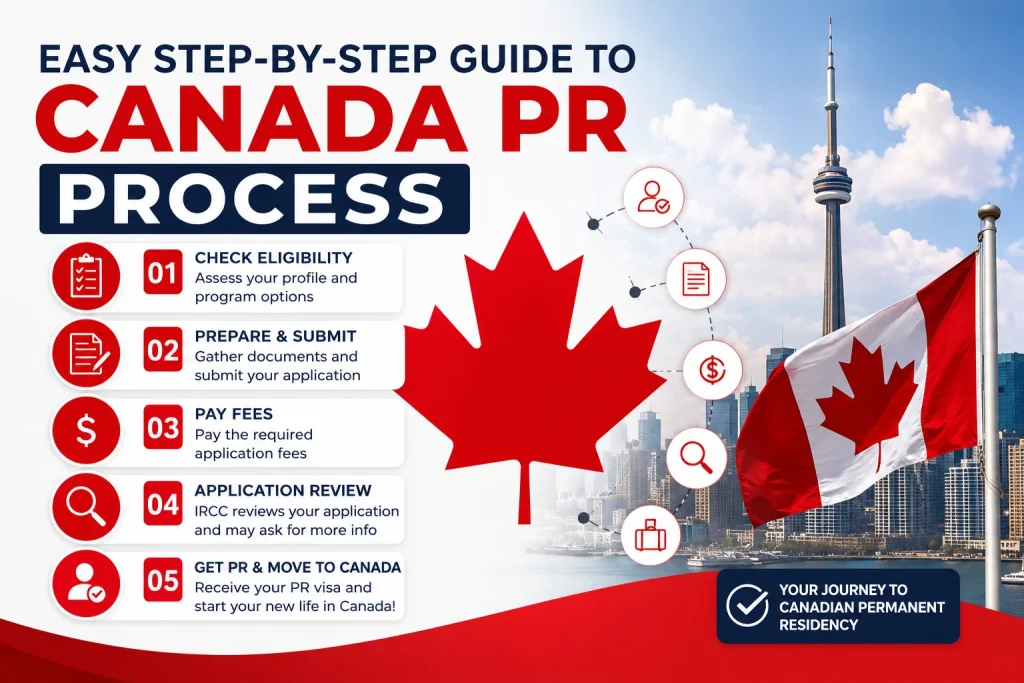
you pick a pathway (mostly Express Entry or PNP), take a language test, get your degree assessed (ECA), create an online profile, wait for an Invitation to Apply (ITA), submit your full application with documents, do your medical and police check, and then receive your Confirmation of Permanent Residence (COPR).
Most Express Entry applicants with a complete file get a decision in around 6 months after ITA, but total time from your first step (language test + ECA) to landing in Canada is usually 8–14 months. A provincial nomination adds 600 CRS points, which almost guarantees an ITA at the next draw.
What Changed in 2026: The Latest Canada PR Updates
Before you start, it helps to know where things stand right now, because the rules shift every few months:
- Permanent Resident target held steady at 380,000/year for 2026, 2027, and 2028 — while temporary resident (student and worker) intake has been cut sharply, which means less competition from temporary-to-permanent conversions.
- Economic immigration is now the priority, making up about 64% of all PR admissions, driven mainly by Express Entry and PNP.
- CRS cutoffs are highly program-specific. General/all-program draws have been landing in the 510s–520s range, while category-based draws (healthcare, French-language, skilled trades, agriculture) and PNP-linked draws have cleared with much lower or much higher scores depending on the category.
- PNP nominations remain the strongest boost to your CRS score, adding 600 points that virtually guarantee your next ITA.
- New one-time transition pathways are letting select groups already in Canada — including certain temporary workers and protected persons — move to PR faster over 2026–2027.
The Complete Canada PR Process: Step by Step
-
Step 1: Pick Your PR Pathway
Most Indian applicants use one of three routes: Express Entry (Federal Skilled Worker, Federal Skilled Trades, or Canadian Experience Class), the Provincial Nominee Program (PNP), or family sponsorship. Read our full breakdown of the Canada immigration programs to see which one fits your profile, education, and work background.
-
Step 2: Take Your Language Test
You need IELTS, CELPIP, or PTE Core for English (or TEF for French). A CLB 7 or higher is generally the minimum for express Entry, but higher bands (CLB 9+) push your CRS score up significantly.
-
Step 3: Get Your Education Credential Assessment (ECA)
Your Indian degree needs to be assessed by an approved body such as WES so IRCC knows its Canadian equivalent. This is mandatory before you can enter the Express Entry pool.
-
Step 4: Calculate Your CRS Score and Check Where You Stand
Use a Canada PR points calculator to see your Comprehensive Ranking System (CRS) score before you commit time and money. If your score is below the recent general-round cutoffs, look at ways to raise it — a provincial nomination, a valid job offer, or your spouse's credentials can all add points.
-
Step 5: Create Your Express Entry Profile
Once your documents and scores are ready, you submit your profile on the IRCC portal. If you're eligible, you enter the pool and get ranked against everyone else using your CRS score.
-
Step 6: Apply for a Provincial Nomination (Optional but Powerful)
If your CRS score is below the general cutoff, a nomination through a Provincial Nominee Program (PNP) is the fastest way to close the gap. A nomination adds 600 points and almost guarantees your ITA at the next draw — many applicants use this route specifically because general Express Entry cutoffs have been sitting above 500.
-
Step 7: Receive Your Invitation to Apply (ITA)
IRCC runs draws roughly every two weeks. If your CRS score meets or beats the cutoff for that round, you get an ITA and 60 days to submit your complete application.
-
Step 8: Submit Your Complete PR Application
This includes your passport, ECA, language results, proof of funds (roughly CAD 14,000+ for a single applicant, more for families), police clearance certificates, and, if applicable, your provincial nomination letter. An incomplete file is the single biggest cause of delay at this stage.
-
Step 9: Medical Exam and Background Checks
You'll complete a medical exam with an IRCC-approved panel physician and provide police clearance certificates from every country you've lived in for 6+ months since turning 18.
-
Step 10: Get Your COPR and Land in Canada
Once approved, you receive your Confirmation of Permanent Residence (COPR) and PR visa (if applicable). You then have a set window to land in Canada and activate your permanent resident status.
Canada PR Pathway Comparison
| Pathway | Best For | Typical Timeline |
|---|---|---|
| Express Entry (FSW/FSTP/CEC) | Skilled workers with strong CRS scores | ~6 months after ITA |
| Provincial Nominee Program (PNP) | Applicants below general CRS cutoff, or with province-specific ties | Nomination: 2–6 months; PR after: 6 months |
| Family Sponsorship | Spouses, partners, dependent children | 12 months (spouse/partner) |
Documents Checklist for Canada PR
- Valid passport
- Language test results (IELTS/CELPIP/PTE Core or TEF)
- Educational Credential Assessment (ECA)
- Proof of funds
- Provincial nomination certificate (if applicable)
- Police clearance certificates
- Medical exam confirmation
- Passport-size photographs
Frequently Asked Questions
How long does the Canada PR process take in 2026?
From your first language test to landing in Canada, most applicants take 8–14 months. The federal processing step after ITA is typically around 6 months for a complete application, but PNP nominations, document delays, or additional verification can extend this.
What is a good CRS score for Canada PR in 2026?
General/all-program Express Entry draws have recently cleared in the 510s–520s CRS range. Category-based draws (healthcare, French language, trades, agriculture) and PNP-linked draws have cleared at different, sometimes much lower, cutoffs. A provincial nomination adds 600 points, which covers almost any gap.
Is Express Entry or PNP faster for Canada PR?
Express Entry is generally faster once you have a competitive CRS score, since it skips the extra nomination step. PNP takes longer upfront (you wait for a provincial nomination first) but is often the only realistic route if your CRS score sits below general cutoffs.
Can I apply for PNP and Express Entry at the same time?
Yes. Many applicants keep an Express Entry profile active while also applying to relevant PNP streams, since a nomination simply adds points to your existing profile rather than replacing it.
How much money do I need to show for Canada PR?
Proof of funds requirements depend on family size — a single applicant typically needs to show roughly CAD 14,000, with higher amounts required for each additional family member. This isn't required if you already have a valid job offer or are applying from inside Canada.
Talk to a Registered Canada Immigration Consultant
Canada PR rules, CRS cutoffs, and PNP streams change often, and small errors in your Express Entry profile or documents can cost you months. GIEC Global's in-house RCIC-registered consultants can review your profile, calculate your realistic CRS score, and guide you toward the fastest genuine pathway — whether that's Express Entry, a provincial nomination, or family sponsorship.