Skip to content
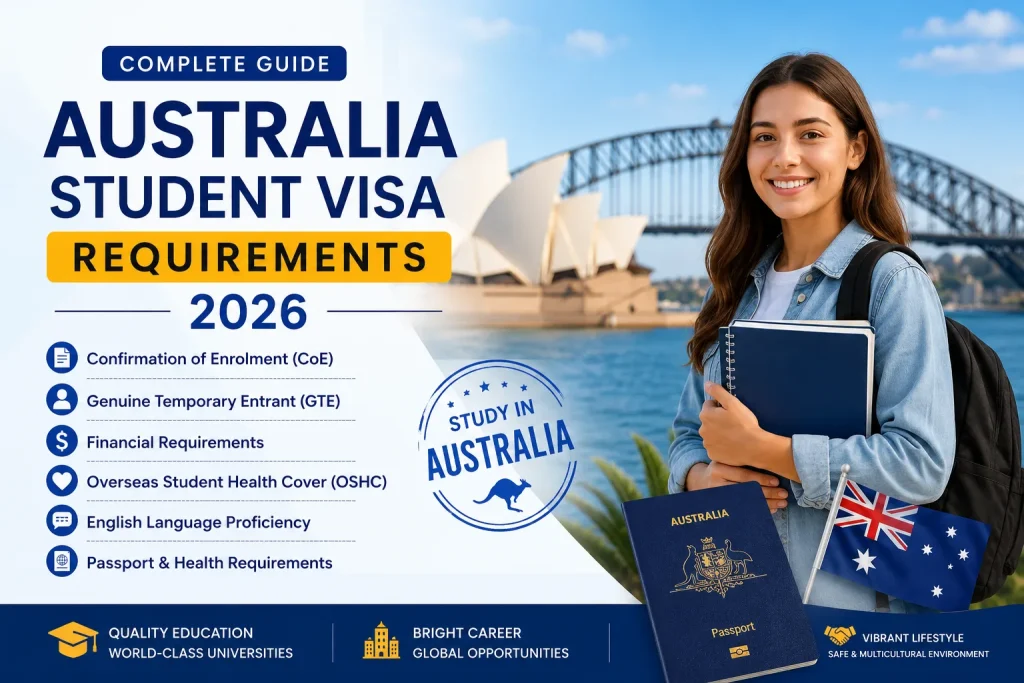
Australia Student Visa Requirements 2026: Complete Guide for Indian Students
Everything you need for the Subclass 500 visa in 2026 — documents, fees, the Genuine Student requirement, and why more Indian applications are getting rejected this year.
- Visa type: Subclass 500 (Student Visa) — needed by every international student studying full time in Australia.
- Visa fee: AUD 2,500 (about ₹1,69,552) for the primary applicant from 1 July 2026.
- Money you must show: AUD 29,710/year (about ₹16.5 lakh) for living costs, plus tuition and return airfare.
- English score: IELTS 6.0 overall (or equivalent) in most cases.
- Big 2026 change: The Genuine Student (GS) requirement has fully replaced the old GTE test, and India has been moved to Evidence Level 3 (EL3), meaning tougher scrutiny.
- Processing time: Usually 4 to 8 weeks from India, but incomplete GS answers or unclear funds can push this much longer.
- Work rights: 48 hours per fortnight while classes are on, unlimited during breaks, no cap for Masters by research or PhD students.
What Is the Australia Student Visa (Subclass 500)?
The Subclass 500 is the only visa that allows you to study full time in Australia for more than three months at a CRICOS-registered institution. Whether you are heading into a diploma, bachelor’s, master’s, or PhD program, this is the visa you will apply for. It typically covers the full length of your course, and it allows limited part time work alongside your studies.
2026 has brought some of the sharpest changes to this visa in years: a new visa fee, a stricter assessment framework for high-volume source countries like India, and a priority processing system tied to how compliant your chosen institution is. If you are applying from India, understanding these changes before you lodge your application matters more than ever.
Who Needs This Visa
- Anyone enrolling in a CRICOS-registered course for longer than three months
- Undergraduate, postgraduate, vocational (VET), and doctoral students
- Students who have completed a short ELICOS (English language) course and are moving into their main program
If you are only accompanying a student as a guardian, or coming for a short training program, different visa subclasses (590 or 407) apply instead.
Eligibility Checklist for 2026
To be eligible for the Subclass 500 visa, you must be able to tick off all of the following:
- A valid Confirmation of Enrolment (CoE) from a CRICOS-registered provider, issued through the PRISMS system
- Proof you meet the Genuine Student (GS) requirement
- Enough money to cover tuition, living costs, and travel for at least the first year
- An acceptable English test score, unless you qualify for an exemption
- Overseas Student Health Cover (OSHC) for your entire visa period
- A clean health examination and character (police clearance) result
- No visa condition breaches from any earlier stay in Australia
Documents You Will Actually Need
| Document | Why it matters |
|---|---|
| Confirmation of Enrolment (CoE) | Mandatory. The visa application cannot be lodged without it, and the name on it must match your passport exactly. |
| Valid passport | Should have validity well beyond your intended course length. |
| GS statement responses | Short written answers inside the online form, capped at 150 words each. |
| Financial evidence | Bank statements, education loan sanction letter, or scholarship/sponsor letter showing funds with a believable history. |
| English test result | IELTS, PTE, TOEFL iBT, or another accepted test, unless exempted. |
| Academic transcripts and certificates | Used to check your GS story lines up with your background. |
| OSHC policy confirmation | Must cover you from your arrival date through your full visa validity. |
| Health examination report | From a Department-approved panel physician. |
| Passport-size photographs and biometrics | Collected at a VFS Global Australian Visa Application Centre in Delhi, Mumbai, Chennai, Hyderabad, Bengaluru, Kolkata, or Ahmedabad. |
The Genuine Student (GS) Requirement, Explained Simply
Since 23 March 2024, the Genuine Student requirement has replaced the older Genuine Temporary Entrant (GTE) test. It is not a separate document anymore. It is built into the online visa form as a set of short questions, each with a 150-word limit, answered directly in English.
Case officers use your answers to judge:
- Why you picked this specific course and this specific institution
- How the course connects to your academic background and career plans
- Your understanding of what studying and living in Australia will involve
- Your ties to home, including family, community, and financial circumstances
- How you plan to fund your stay, and what you intend to do after the course ends
Officers give more weight to answers that are backed by actual evidence, not just a well-written paragraph. A generic statement that could apply to any student, for any course, in any country, is one of the fastest ways to get refused.
Financial Requirement in 2026
You must show access to enough money to cover your first 12 months of study. As of 2026, the figures are:
| Category | Amount (AUD) | Approx. INR |
|---|---|---|
| Single student, living costs | 29,710 / year | ₹16.5 lakh |
| Partner or spouse | 10,394 / year | ₹5.8 lakh |
| Each dependent child | 4,449 / year | ₹2.5 lakh |
| Tuition fees | First year, as per CoE | Varies by course |
| Return airfare | As applicable | ₹40,000–₹1,20,000 |
Acceptable proof includes bank statements with a stable transaction history, an approved education loan, a scholarship letter, or a sponsor's financial documents. A single large deposit made just weeks before you apply is a known red flag for case officers, since it does not demonstrate genuine, ongoing access to funds. If your loan or savings were recently topped up, keep clear paperwork showing where that money came from.
English Language Requirement
Most Subclass 500 applicants need an overall IELTS score of 6.0 (or an equivalent score in PTE, TOEFL iBT, or another accepted test), with specific band requirements set by your institution. Students who score below this can sometimes still qualify by first completing an ELICOS (English language) course before their main program begins. Always check your institution's own English requirement too, since it can be higher than the visa minimum.
Visa Fees and Real Costs in 2026
| Cost item | Amount |
|---|---|
| Subclass 500 visa fee (primary applicant, from 1 July 2026) | AUD 2,500 (about ₹1,69,552 lakh) |
| ASEAN / ELICOS or non-award concession fee | AUD 2,050 |
| Additional applicant aged 18+ (partner) | AUD 2,500 |
| Dependent child under 18 | AUD 625 |
| OSHC (single student, per year) | AUD 500–700 |
| Health examination | AUD 300–500 (paid to the panel physician) |
| Biometrics at VFS Global | ₹5,000–7,000 |
This makes Australia's Subclass 500 one of the most expensive study visas in the world right now, well above comparable charges in the UK or Canada. Budget for the visa fee, OSHC, and medical costs on top of tuition when planning your total study budget, since none of these are refundable if your application is refused.
Health and Character Requirements
Every applicant must pass a health examination by a Department-approved panel physician, who uploads results directly into the system. You will also need to meet character requirements, which usually means providing a police clearance certificate if you have lived in a country for 12 months or more in the last 10 years. A visa can be refused on character grounds even where every other requirement is met, so this step should not be treated as a formality.
Step by Step Application Process
- Get your offer and pay the deposit to your chosen CRICOS-registered institution.
- Receive your eCoE through PRISMS once your offer is confirmed.
- Buy OSHC covering your full intended stay.
- Create an ImmiAccount on the Department of Home Affairs website.
- Complete the GS questions carefully, in your own words, backed by real evidence.
- Upload financial, academic, and identity documents.
- Pay the visa fee and submit the application.
- Complete biometrics at your nearest VFS Global centre, if required.
- Complete your health exam with a panel physician.
- Wait for a decision, responding quickly to any request for more information.
Processing Time From India
Most Subclass 500 applications from India are processed within 4 to 8 weeks, though this varies by institution and how well-documented your application is. Since 14 November 2025, Ministerial Direction 115 has introduced a new priority processing order: applications tied to institutions with a strong compliance history and that stay within the government's 2026 National Planning Level (295,000 new student commencements nationally) are processed faster than others. A well-prepared application at a compliant institution now has a genuine speed advantage, not just a quality advantage.
Work Rights While Studying
- Up to 48 hours per fortnight while your course is in session (a fortnight runs Monday to Monday, 14 days)
- Unlimited hours during official scheduled course breaks
- No work-hour cap at all for Masters by Research and PhD students
Why Indian Applications Are Getting Rejected More in 2026
From 8 January 2026, India was moved into Evidence Level 3 (EL3), the Department's highest scrutiny tier for student visa applicants, alongside Nepal, Bangladesh, and Bhutan. Reporting through early 2026 pointed to a sharp rise in refusals for Indian applicants compared to prior years, driven mainly by four recurring issues:
- A GS statement that reads as generic or copy-pasted rather than personal and specific
- Financial documents that are incomplete, unclear, or show a suspicious last-minute deposit
- A course choice that does not logically connect to the applicant's academic or work background
- Missing or inconsistent supporting documents
A refusal on genuine student grounds usually comes with no right to merits review, and the visa fee is not refunded. If you are refused, get a clear read on the specific reason cited in your refusal letter before you reapply, rather than resubmitting the same documents with minor tweaks.
Why Choose GIEC Global
With EL3 scrutiny now the norm for Indian applicants, the margin between an approval and a refusal usually comes down to how well your GS narrative and financial paper trail hold together — not how many documents you submit. This is where an experienced consultancy earns its place in your application, rather than being an optional extra.
- Australia-specific migration guidance from MARA-registered agents who track policy shifts like EL3 and Ministerial Direction 115 as they happen, not months later.
- GS statement review that pressure-tests your answers for the specific, evidence-backed detail case officers are trained to look for.
- Financial documentation checks to flag anything — a recent deposit, an unclear loan trail — before a case officer does.
- End-to-end support across CoE, OSHC, biometrics, and health exam scheduling, so nothing slips through at the last stage.
- A multi-country presence (Australia, India, Sri Lanka, UK) means your file is handled by people who understand both sides of the application — where you're applying from and where you're applying to.
None of this guarantees an outcome — no consultancy can promise a visa decision — but a second, expert set of eyes on your GS statement and financials before you submit is one of the few things within your control in a tougher assessment environment.
Get Your Free Australia Student Visa Assessment
Share your details below and a GIEC Global counsellor will review your profile, course choice, and documentation before you lodge your Subclass 500 application.
Frequently Asked Questions
What is the minimum bank balance required for an Australia student visa in 2026?
You need to show access to at least AUD 29,710 for one year of living costs, on top of your first year's tuition fees and return airfare. This is not a fixed "bank balance" figure. It can be met through savings, an education loan, a scholarship, or documented sponsor support.
What IELTS score is needed for the Australia student visa?
Most applicants need an overall IELTS score of 6.0, or an equivalent score in another accepted test. Some institutions ask for higher scores, and students below the minimum can sometimes qualify through a preparatory ELICOS course.
How long does an Australia student visa take to process from India?
Typically 4 to 8 weeks, though this depends on your institution's compliance status under Ministerial Direction 115 and how complete your application is at the time of lodgement.
Why are so many Indian student visas being rejected in 2026?
India was reclassified to Evidence Level 3 in January 2026, which means higher scrutiny on every application. Most refusals trace back to a weak Genuine Student statement, unclear financial proof, or a course that does not fit the applicant's background.
Can I work while studying in Australia on a Subclass 500 visa?
Yes. You can work up to 48 hours per fortnight while your course is in session, and unlimited hours during official breaks. Masters by Research and PhD students have no work-hour cap at all.
How much does the Australia student visa cost in 2026?
The base visa application fee is AUD 2,500 for the primary applicant, effective from 1 July 2026. On top of this, budget for OSHC, a health exam, and biometrics, none of which are included in the visa fee.