Skip to content
What Is the Fastest Way to Get PR in Australia? (2026 Guide)
There is no single "fastest" visa that works for everyone. For most skilled applicants without a job offer, the Subclass 189 Skilled Independent visa is the quickest route because it skips state nomination and employer sponsorship. But if you already have an Australian employer willing to sponsor you, the Subclass 186 Employer Nomination Scheme is usually faster in practice, since it avoids waiting for a SkillSelect invitation round. The real speed of your Australia PR journey depends on your occupation, your points score, and which pathway matches your profile.
Australia's 2026-27 Migration Program: What Changed
The Department of Home Affairs confirmed the permanent Migration Program for 2026-27 remains at 185,000 total places, but the mix has shifted in ways that directly affect how fast you can get invited:
| Visa Stream | 2025-26 Places | 2026-27 Places | What It Means |
|---|---|---|---|
| Skilled Independent (189) | 16,900 | 21,090 | More room for high-scoring applicants without a sponsor |
| Skilled Nominated (190) | 33,000 | 35,500 | Slightly easier state nomination competition |
| Skilled Work Regional (491) | 33,000 | 14,110 | Sharp cut — regional PR is now more competitive |
| Employer Sponsored (186/482) | 44,000 | 58,040 | The biggest jump — sponsorship is now the largest skilled pathway |
| Family Stream (Partner, etc.) | – | 52,460 | Demand-driven, not capped by invitation rounds |
The employer-sponsored category now accounts for the largest share of skilled places, which is one reason many applicants find sponsorship the fastest practical route in 2026, even though the Skilled Independent visa is technically the most "direct" pathway on paper.
Comparing the Fastest Australia PR Pathways
1. Skilled Independent Visa (Subclass 189) — Fastest If You Don't Need a Sponsor
The 189 is the closest thing Australia has to a PR fast-track. You don't need an employer, a state government, or a family member to sponsor you. If your occupation is on the Medium and Long-Term Strategic Skills List and you score well on the points test, you can go straight from Expression of Interest to a grant.
- Minimum points required: 65 (but 85+ is realistic for most invitation rounds)
- Age limit: under 45 at the time of invitation
- Typical processing time: 8 to 18 months from EOI to grant, though invitation rounds themselves are unpredictable and are usually announced only a few days in advance
- No sponsorship, no employer, no state ties required
You can work out where you stand using our free Australia PR Point Calculator before you invest time in an EOI.
2. Employer Sponsorship (Subclass 186) — Often the Fastest in Practice
If you already have a job offer or are working in Australia on a temporary skilled visa, the Employer Nomination Scheme (Subclass 186) frequently moves faster than the 189 because it does not depend on SkillSelect invitation rounds at all. With 58,040 places now allocated to employer-sponsored PR, this pathway has the most breathing room of any category in 2026-27.
- No points test in the Direct Entry stream (though a positive skills assessment is usually still required)
- Requires a genuine, ongoing job offer from an approved Australian sponsor
- Processing can be considerably shorter once nomination is approved, since there is no invitation queue to wait in
3. Skilled Nominated Visa (Subclass 190) — Good Backup If You're Short on Points
If your points score doesn't quite clear the bar for a 189 invitation, a state or territory nomination adds 5 points and can move you into invitation range much sooner. Places rose modestly to 35,500 for 2026-27, and each state manages its own occupation list and rounds independently of the national SkillSelect timetable.
4. Skilled Work Regional Visa (Subclass 491) — Slower Now Due to Fewer Places
The 491 used to be one of the more accessible pathways, but places were cut from 33,000 to 14,110 for 2026-27 — a drop of more than half. If regional Australia works for your lifestyle, it's still viable, but expect noticeably more competition for nomination this year.
5. Partner or Family Visa — Fastest If You Qualify
If you have a spouse, de facto partner, or eligible family member who is an Australian citizen or PR holder, a partner visa doesn't depend on points, occupation lists, or invitation rounds at all. It runs on its own demand-driven allocation, which can make it one of the quickest routes for applicants who qualify.
What Real Applicants Say About Speed
Several users who initially aimed for a points-tested or talent-based visa found that switching to the Subclass 186 Direct Entry route through an employer turned out to be quicker, with one applicant reporting a decision in under three months once their nomination was lodged.
189 invitation rounds are hard to predict — occupations like nursing, teaching, and construction trades have been receiving invitations more consistently than IT or hospitality roles in recent rounds, according to several migration agencies tracking round-by-round results. This lines up with the government's own shift toward higher employer-sponsored allocations for 2026-27.
Note: Invitation patterns and "priority occupation" trends reported by migration agencies are observations based on past rounds, not official Department of Home Affairs policy. Always confirm current occupation ceilings and rounds directly through SkillSelect before making decisions.
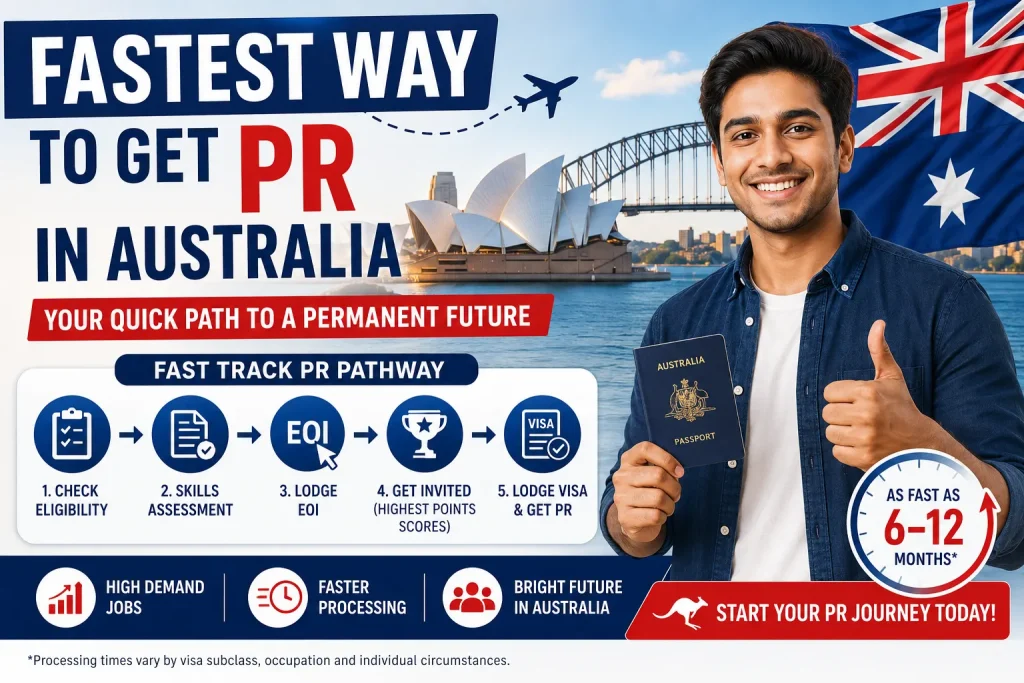
Step-by-Step: How the Application Process Works
- Check your occupation and points: Confirm your job is on the relevant skilled occupation list and estimate your score.
- Get a skills assessment: Apply to the assessing authority for your occupation (for example, ACS for IT, ANMAC for nursing, VETASSESS for many other roles).
- Take an English test: IELTS, PTE Academic, or another accepted test. Higher scores mean more points.
- Submit your Expression of Interest (EOI): Register in SkillSelect with your points, occupation, and preferences.
- Wait for an Invitation to Apply (ITA): Based on your score, occupation ceiling, and date of effect.
- Lodge your visa application: You generally have 60 days from your ITA to submit your full application with medicals and police checks.
5 Ways to Speed Up Your Australia PR
- Maximise your English test score — Superior English (proficient or above) can add up to 20 points.
- Get your skills assessed early — Assessments can take weeks to months depending on the authority, so start before you plan to submit your EOI.
- Consider a regional or state nomination if your independent points fall short — an extra 5 to 15 points can be the difference between waiting one round or several.
- Explore employer sponsorship if you already have Australian work experience or a job offer, since it now carries the most available places.
- Keep your EOI updated — correct any change in employment, test scores, or partner details immediately, since your points and date of effect both affect your place in the queue.
If you're specifically weighing a trade or vocational pathway, our breakdown of trade courses in Australia for PR covers realistic timelines for that route as well.
Frequently Asked Questions
What is the single fastest visa to get PR in Australia?
For applicants without a sponsor, the Subclass 189 Skilled Independent visa is the most direct pathway. For applicants with an Australian job offer, the Subclass 186 Employer Nomination Scheme is often faster in practice because it skips SkillSelect invitation rounds entirely.
How many points do I need for Australia PR in 2026?
The minimum is 65 points, but most successful 189 invitations in recent rounds have gone to applicants scoring 85 or higher. Requirements vary by occupation and by visa subclass.
How long does the Australia PR process take in 2026?
Most skilled visa pathways take 8 to 18 months from Expression of Interest to grant, though this varies significantly by occupation ceiling, points score, and which visa subclass you apply for.
Can I get Australia PR without a job offer?
Yes. The Subclass 189 visa does not require a job offer, employer sponsor, or state nomination — only a qualifying occupation, a positive skills assessment, and a competitive points score.
Is employer sponsorship faster than the points-tested visas?
It can be, especially in 2026-27 now that employer-sponsored places have increased to 58,040. Since there's no SkillSelect invitation round to wait for, processing can move faster once your employer's nomination is approved.
Talk to a Registered Migration Expert
Not sure which Australia PR pathway is fastest for your profile? Get a free assessment from our team.